September 28, 2026
Ancient Games You Can See in World Museums
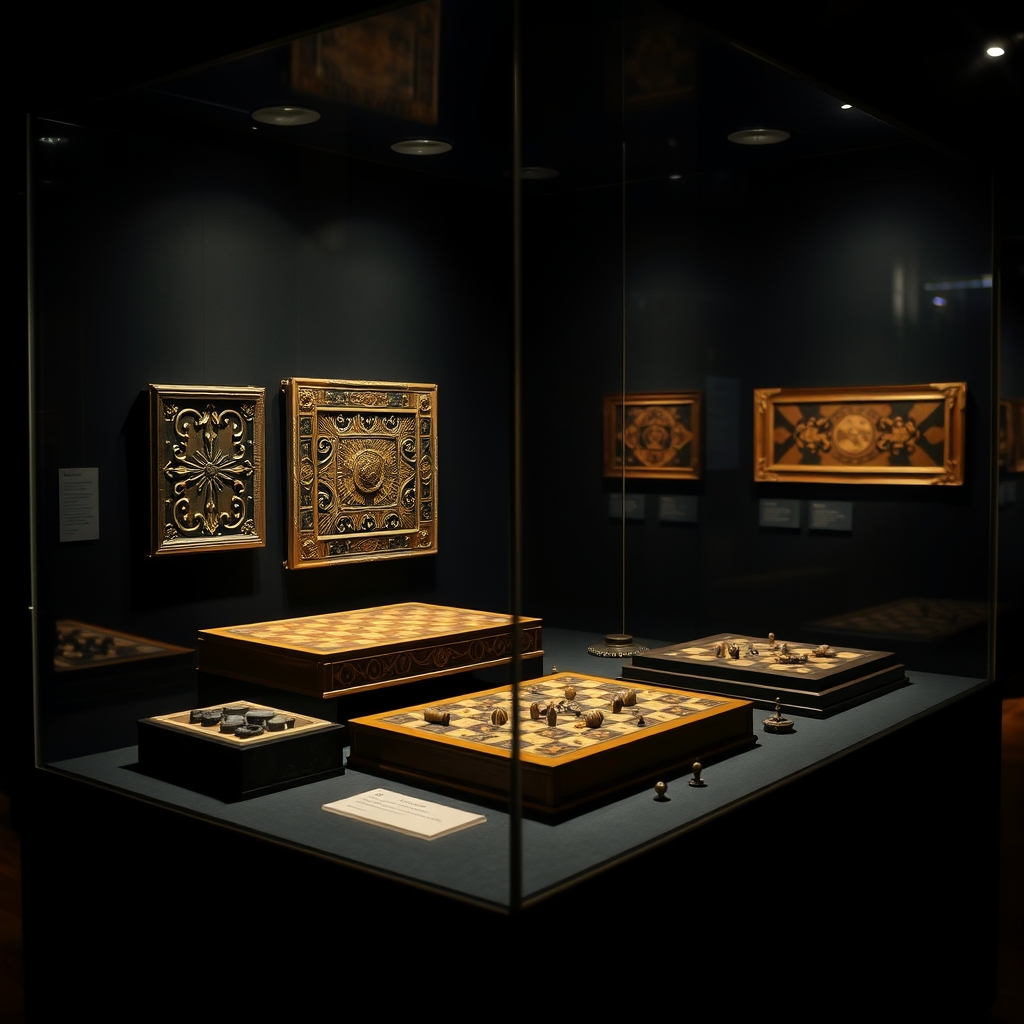
Every reconstruction begins with an original: an object behind glass, excavated from a tomb or a refuse pit, carrying the wear of hands long turned to dust. If our replicas have stirred your curiosity, it is worth knowing where the genuine artifacts rest. Several of the world’s great museums hold the boards that defined ancient play, and standing before them is a different experience from reading about them.
The British Museum, London
The British Museum holds the most celebrated of all ancient gaming finds: the boards from the Royal Cemetery of Ur, excavated by Leonard Woolley in the 1920s and dating to roughly 2600 to 2400 BC. Among them is the shell-and-lapis-lazuli board that has become the face of the Royal Game of Ur. The museum’s importance runs deeper than the board itself: it was the curator Irving Finkel who, working from a cuneiform tablet inscribed by a Babylonian scribe around 177 BC, reconstructed the game’s long-lost rules. The same collections preserve examples of Nine Men’s Morris and other games from across the ancient and medieval worlds.
The Egyptian Museum, Cairo
No game is more bound to Egypt than senet, the board of the afterlife, and no senet board is more famous than the one found in the tomb of Tutankhamun. That set, a fine playing box mounted on a stand with its drawer of pieces, is held in the Egyptian Museum in Cairo, among the pharaoh’s funerary treasures. Senet was played along the Nile for some three thousand years, and the Cairo collections trace that long arc, showing how a simple crossing game became, by the New Kingdom, a rehearsal for the soul’s journey through the underworld.
The Metropolitan Museum of Art, New York
For travelers in the United States, the Met offers an unusually full gathering of ancient board games under one roof. Its Egyptian galleries display both senet and the related game of twenty squares, the Egyptian cousin of the Royal Game of Ur, and its scholarship has done much to clarify how the two were played. The Met is also a useful reminder that a single track-and-race idea could surface in Egypt, Mesopotamia, and the eastern Mediterranean alike, carried along the same trade routes that moved grain and gold.
Seeing with your hands
There is a limit to what a museum can offer. The boards must stay behind glass; the dice cannot be thrown; the games cannot be played. That is the gap our work is meant to close. We study the originals, their dimensions, their materials, and the placement of every rosette and square, so that the object you hold answers to the one in the case.
If a visit is not in your near future, you can still bring the cabinet home. Explore our faithful reconstruction of the Royal Game of Ur, modeled on the board in the British Museum, and play the game its keepers can only describe.